
Backend on FastAPI from scratch
From an empty folder to a public HTTPS URL of your API on the internet. Not another hello-world but a real backend: registration, a database with migrations, protected endpoints, tests, and auto-deploy — something you can put on your resume.
- An API with PostgreSQL, Alembic migrations, and Swagger docs out of the box
- Registration, JWT tokens, and endpoints isolated from other users' data
- Tests with transaction rollback, a Docker container, and auto-deploy to free hosting
The course is part of premium — together with the other advanced courses, the AI assistant and certificates.
What changes after the course
Course program
Each lesson is short theory on live examples plus practice in the trainer with auto-checking. Nothing to install: Python runs right in the browser.
How the learning works
Read a lesson with live examples
Theory without filler: every code example can be run and edited right in the browser, with the result shown instantly.
Solve tasks in the trainer
You write code and the answer is checked automatically against a set of tests. No local environment setup.
Stuck — the AI mentor helps
The built-in assistant points out where the error is and nudges you toward the solution without giving it away.
Who is this course for
Finished Python basics and want a profession
You know functions, lists and dicts but don't see how a real interview-ready backend grows out of them.
A frontend dev tired of waiting for someone else's API
You want to bring up the server, the database and the endpoints yourself instead of asking a backender for one more route.
An analyst or tester moving into development
You already write Python scripts and want a real service with a database, auth and deploy on your resume.
You'll need Python basics — variables, functions, lists and dicts. If you don't have them yet, start with the free "Python Basics" course, then come back.
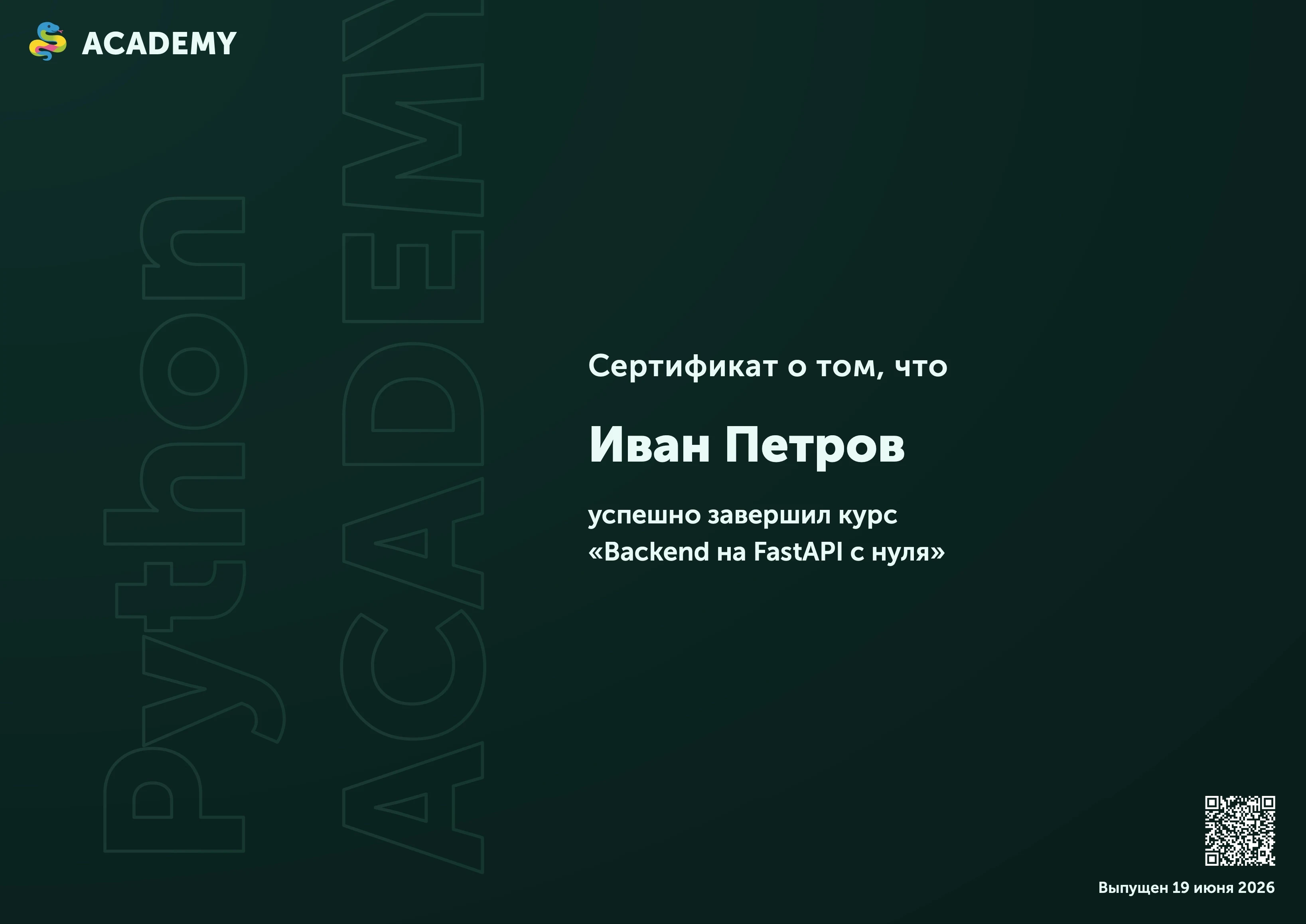
A certificate you can verify
Complete all the lessons and get a named certificate of completion. You can add it to your resume or your LinkedIn profile.
What students say


One premium — all courses at once
You're buying not a single course but the whole Python Academy premium: the advanced courses and every trainer feature.
- Access to advanced Python courses
- Unlimited hints from AI Assistant
- Access to tasks from top company interviews
- Access to reference solutions for tasks
- Certificate of successful completion of Python tasks in the trainer
Secure payment by Russian card via YooKassa or by international card via Stripe. Access opens right after payment.
Frequently asked questions
Yes, this course is designed exactly for that point: beyond basic functions, classes, and loops, it doesn't assume anything. Backend, HTTP, databases, JWT, and Docker — we introduce all of these from scratch, with a short explanation right in the lesson where each new term first appears.
A public URL like https://<your-app>.onrender.com pointing at your own API on the internet. Anyone can register, log in, and create a task through it — a real backend, not a learner's hello-world. Plus a GitHub repository where each step of the course sits under its own git tag — perfect to share on your resume or in interviews.
Around 15 hours of reading and coding — that's seven or eight evenings of about two hours, or three to four focused weekends. Every lesson is self-contained — you can pause and resume any time, since the code state for each step is always on GitHub under its own tag, ready to clone and continue from.
Python 3.11+, Docker, and any IDE with Python support (VS Code, PyCharm — whatever you prefer). All libraries (FastAPI, SQLAlchemy, Alembic, pytest, and the rest) we install as we go. If Docker feels intimidating — there's a dedicated lesson explaining containers in plain terms, and you don't need to touch Docker until then.